Mazda's R&D team has been working to standardize optimal structures across different vehicle models and
classes, guided by the "Common Architecture" strategy introduced by Mazda in 2006. By applying black-box
optimization powered by Ising machines (quantum/quantum-inspired technologies) to this cross-model structural
design challenge, the team successfully identified solutions that are equal to or better than those produced
by leading conventional methods—using just 3% as many trial runs. We spoke with the team about the details of
their presentation at the 2024 JSAE (Society of Automotive Engineers of Japan) Autumn Congress, the journey to
achieving these results, and their plans for the future.
Interview Topics
-
A breakthrough after years of persistent effort
-
Trial and error in effectively harnessing quantum annealing and Ising machines
Could you give us an overview of the paper you presented at the 2024 JSAE Autumn
Congress?
Mr. KondoIn this paper, we applied black-box optimization using quantum
annealing and Ising machines to the "simultaneous structural design optimization problem for multiple vehicle
models," and reported our findings. We also discussed our approaches to dynamic weight adjustment for
efficiently discovering superior solutions, as well as multi-point search strategies designed to avoid local
optima.
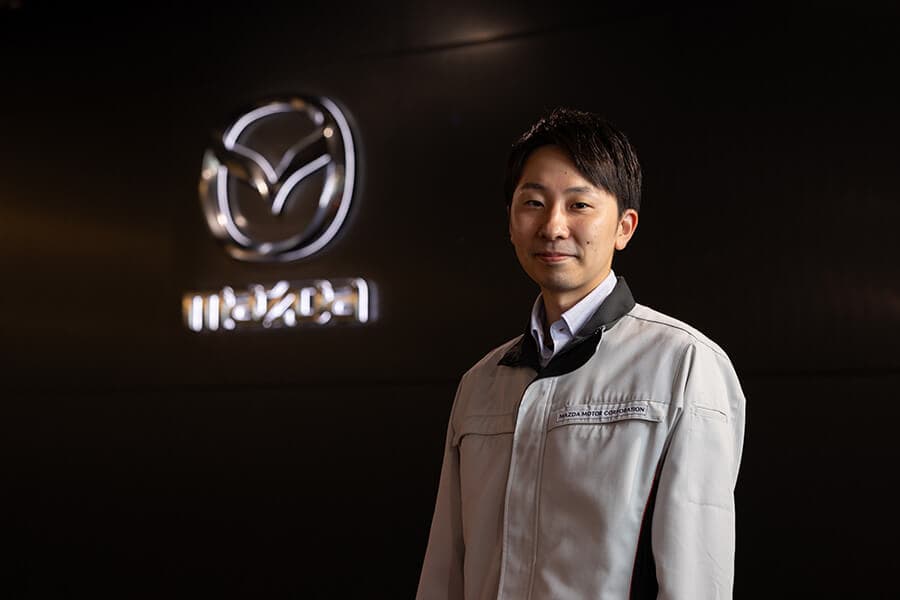 Mr. Kondo: "We were astonished when just 1,000 trials yielded better solutions than 30,000 trials
with conventional methods."
Mr. Kondo: "We were astonished when just 1,000 trials yielded better solutions than 30,000 trials
with conventional methods."
Inside a car body, there are critical components that form the vehicle's "skeleton" (Figure 1). This skeleton
is not made from steel plates of uniform thickness; rather, it consists of numerous parts, each manufactured
from steel plates of varying thickness suited to its specific function. The simultaneous structural design
optimization problem we tackled involves three vehicle commercial models, each with 74 locations (a total of
222). The challenge was to determine the optimal steel plate thickness for each location. This is a
multi-objective optimization problem that minimizes vehicle weight and maximizes the number of shared parts
across models, while satisfying quality constraints—such as ride comfort and crash performance—for each model.
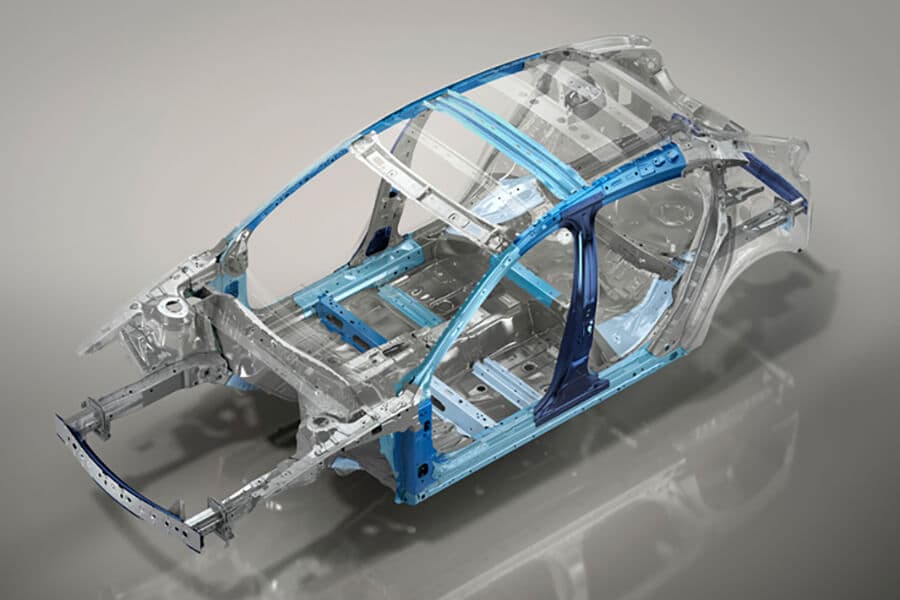 Figure 1: Steel plates inside a car body (Source: https://autoc-one.jp/news/5003621/
 )
)
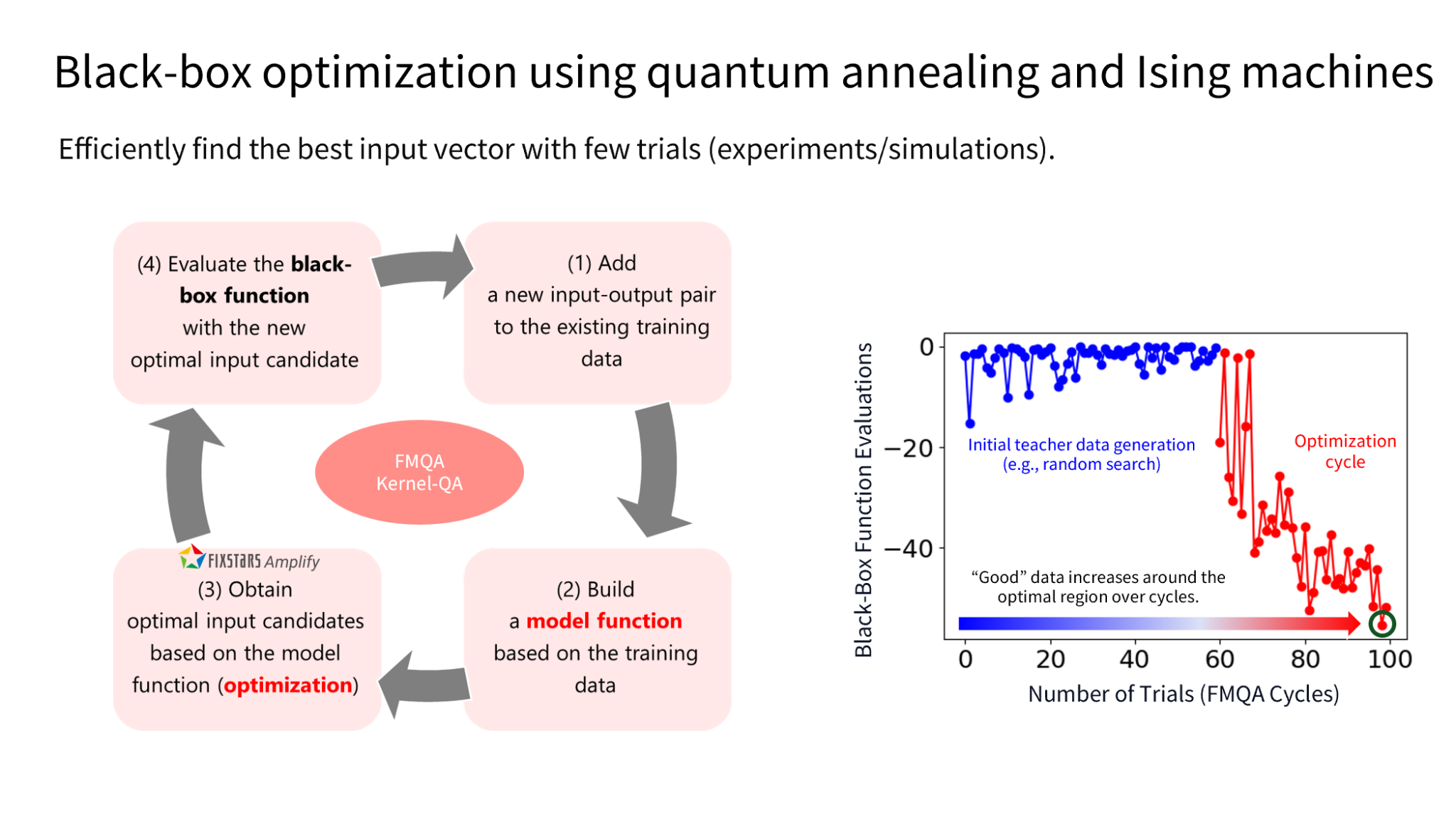
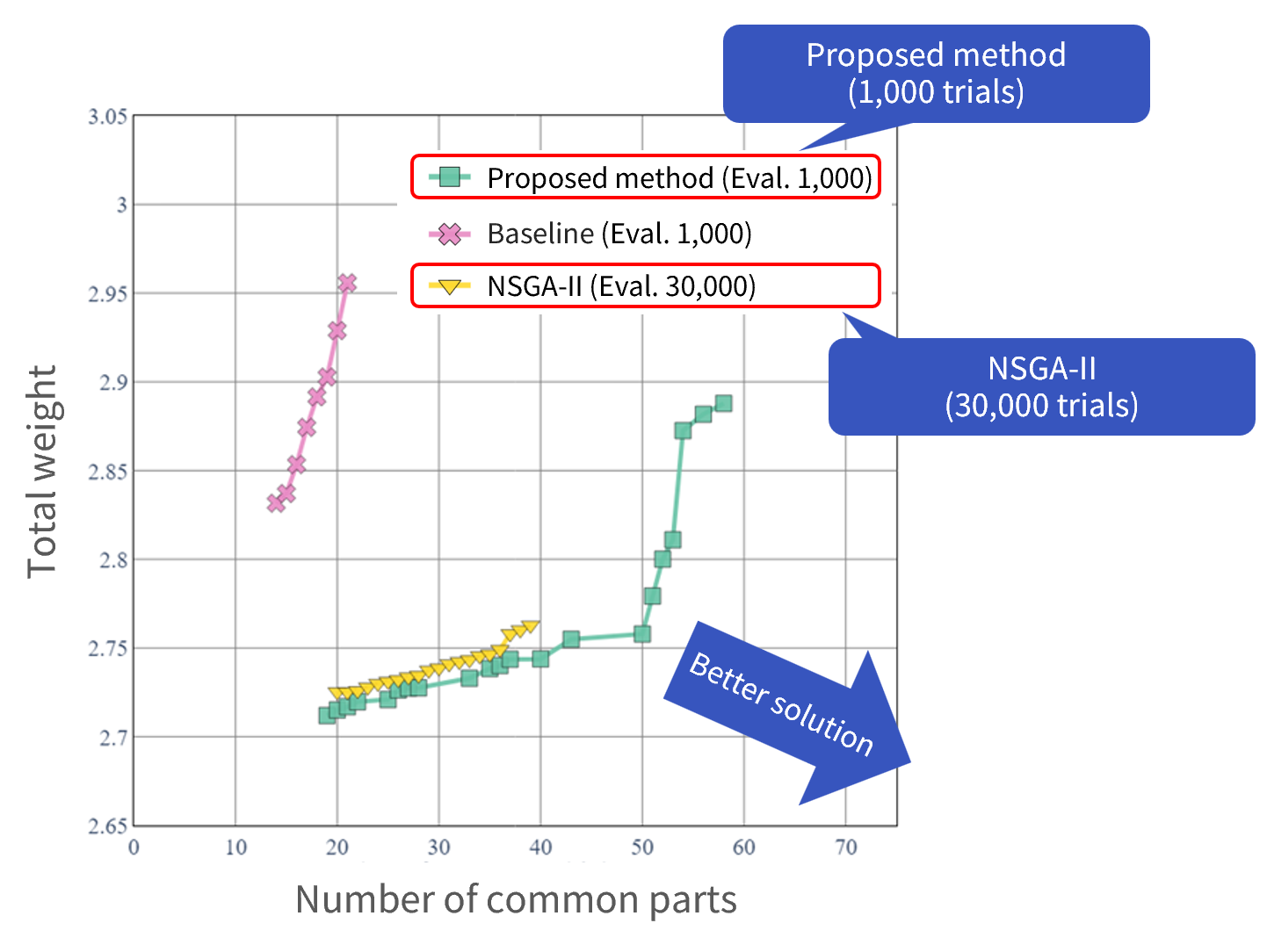
Using black-box optimization powered by quantum annealing and Ising machines, we found solutions in just 1,000
trials that outperformed those obtained after 30,000 trials with NSGA-II, a widely used evolutionary
computation method for multi-objective optimization.
 Black-box optimization using quantum annealing and Ising machines (click
image to enlarge)
Black-box optimization using quantum annealing and Ising machines (click
image to enlarge)
 Results obtained in this study (click image to enlarge)
Could you tell us about previous efforts to address the simultaneous structural design
optimization problem for multiple vehicle models?
Mr. KohiraThis work is part of the “Monozukuri Innovation” initiative that
Mazda launched internally in 2006. Within that initiative, there is an effort called “Common Architecture,”
which aims to standardize designs across different vehicle models and classes. To achieve this
standardization, we have explored and validated a variety of methods for each specific theme.
For this particular optimization problem of optimizing steel plate thickness, we collaborated with Japan
Aerospace Exploration Agency (JAXA) and Tokyo University of Science between 2014 and 2015, attempting to solve
it using evolutionary-computation-based methods on supercomputers. While we confirmed that the problem could
be solved with this approach, the data obtained—using 10% of the total computational capacity of the “K”
supercomputer—revealed that conventional techniques would require tens of thousands of trials and several
months of computation to obtain reasonable Pareto-optimal solutions. It became clear that further innovation
was needed for practical application.
Subsequently, in 2017, we publicly released the simultaneous structural design optimization problem for
multiple vehicle models as a “benchmark problem.” At the time, evolutionary computation research was primarily
conducted in academia. However, typical benchmark problems used for evaluation often differed significantly
from real-world applications, making it difficult to validate performance on practical problems. To bridge
this gap, we published the “actual” problem we wanted to solve as a benchmark. To illustrate the difficulty of
this benchmark problem: if there are 10 thickness options for each location, the total number of combinations
is 10^222. Even with 100,000 random search trials, no feasible solution could be found.
In 2022, a research group from the University of Oxford and Meta published a paper that applied Bayesian
optimization methods to our benchmark problem*1. They reported that standard multi-objective
Bayesian optimization methods at the time failed to find not only optimal but even feasible solutions. The
group then proposed a new multi-objective Bayesian optimization method. While their approach found feasible
solutions in 10,000 trials, solution quality remained limited. We had also been working on Bayesian
optimization ourselves, but as the problem size increased, finding constraint-satisfying solutions became
extremely difficult. These limitations motivated us to explore alternative approaches.
*1 Daulton, S., Eriksson, D., Balandat, M., & Bakshy, E. (2022, August). Multi-objective
bayesian optimization over high-dimensional search spaces. In Uncertainty in Artificial Intelligence (pp.
507-517). PMLR.
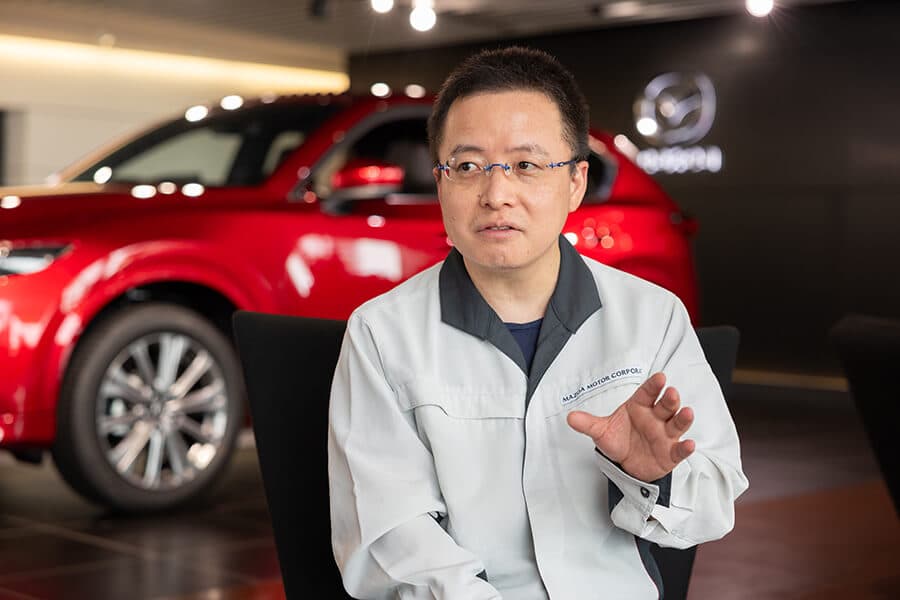 Mr. Kohira: "I was very intrigued—this might be a method that could overcome the challenges we
faced with Bayesian optimization."
Mr. Kohira: "I was very intrigued—this might be a method that could overcome the challenges we
faced with Bayesian optimization."
How did you come to work with Fixstars Amplify?
Mr. KohiraWe had been investigating quantum technologies since around 2020. We
shared our work with a partner systems integrator, who introduced us to Fixstars Amplify. Through our previous
research, we knew that applying quantum technologies comes with various limitations, and we were skeptical
about whether they could be effectively applied to our large-scale, complex challenges. As a result, we
initially had low expectations for Fixstars Amplify. However, we decided to join Q-STAR (Quantum STrategic
industry Alliance for Revolution)*2, which was introduced during a meeting, and participated in
hands-on training provided by Fixstars Amplify through Q-STAR. Through that training, we found that the
Fixstars Amplify SDK is user-friendly, and the large number of sample code examples on their website are
useful. We felt that we could experiment and iterate on our own, which increased our interest. In addition,
the black-box optimization approach introduced to us in early 2023 caught our attention—we thought it might
overcome the challenges we had encountered with Bayesian optimization.
*2 https://qstar.jp/
What were the challenges and highlights of this research?
Mr. KondoOne of the main challenges was that, while Fixstars Amplify is
straightforward and user-friendly, we still needed knowledge specific to Ising machine optimization. I had
been working on optimization—primarily evolutionary computation—since my student days, but I ran into several
difficulties with Ising machine-based optimization. When I first worked on FMQA, I focused solely on weight
minimization as a single objective, but the process was time-consuming, and the weight reduction fell short of
expectations—the optimization simply was not progressing well. After consulting with Fixstars Amplify, we
discovered that the binarization of design variables was not working as intended and that the
FM (factorization machine) training was not progressing properly. Later, when we transitioned to
multi-objective optimization by adding the maximization of shared parts as an additional objective, we also
struggled with balancing (scaling) between the objective functions.
Every time we faced a challenge, we consulted with the Fixstars Amplify team, and they were incredibly
generous in openly sharing their optimization expertise. When needed, they even created and provided sample
programs. That was tremendously helpful. It was gratifying to see the optimization finally work well after
incorporating their suggested modifications.
Furthermore, as we reported in our presentation, by effectively leveraging Ising machines with various
refinements, we were amazed to find that just 1,000 trials produced better solutions than 30,000 trials with
conventional methods. The most exciting part was that constraint-satisfying solutions were found within just a
few hundred trials, given that finding such solutions had been one of the greatest difficulties with our
benchmark problem. When used properly, it turned out to be an extraordinarily powerful tool.
Looking ahead, Fixstars Amplify plans to release a black-box optimization library*3 that will
simplify steps such as binarization, making the approach even more accessible. In the future, we would also
like to apply this technology to other problems beyond the one we addressed this time.
*3 The black-box optimization library, Amplify-BBOpt, was released after the interviews.
See: https://amplify.fixstars.com/en/docs/amplify-bbopt/v1/
What is the outlook for steel plate thickness optimization going forward?
Mr. KohiraThe strong results we achieved this time should help build momentum
for internal discussions. That said, we are still at the research stage, with the primary focus on how quickly
we can find the best possible solutions. To turn this into a tool that design teams use daily, there are still
several milestones.
Mr. KondoIn particular, for a tool used in day-to-day design work, we need to
be able to consistently obtain reasonably good solutions—even if not the absolute best—with a small number of
trials. I think this will be a major challenge. Beyond that, we also need to work on systematization and
parameter-free operation so that any designer can use it easily. We look forward to continuing this work in
collaboration with Fixstars Amplify.
Finally, what are your expectations for the future of Fixstars Amplify?
Mr. KohiraWe look forward to seeing Fixstars Amplify drive the global adoption
of quantum-inspired computing. When we present our research internationally, we see immense potential for
these technologies to solve complex, black-box optimization problems. The accumulation of high-impact use
cases will benefit the entire industry. We are excited to see them set the standard for the global market.
* All information in this article is based on interviews conducted in September 2024.
Interviewer's Note
We are delighted to have contributed to a major breakthrough in Mazda's long-standing effort to
simultaneously optimize the design of multiple vehicle models. Black-box optimization using quantum
annealing and Ising machines is still a new technology, and we believe it will continue to evolve.
Through this collaboration with Mazda, we at Fixstars Amplify have also gained invaluable knowledge and
experience. We remain inspired by Mazda's commitment to proactively and effectively leveraging
cutting-edge technologies to strengthen its competitive area, and we look forward to continuing
to support their endeavors.
At Fixstars Amplify, we provide R&D support leveraging black-box optimization with quantum annealing
and Ising machines to clients across a wide range of industries. If you are interested, please do not
hesitate to contact us.
Interviewer: Takahisa Todoroki (Senior Director, Fixstars Amplify Corporation)
